


A Wider World
Deathgrave’s Hell Is Evil arrives with the confidence of a band that have pushed their warped musical vision into its clearest form yet. Released August 21 through Tankcrimes, the Bay Area quartet’s third full-length is a compact 32-minute argument for extremity without confinement. Deathgrave still grind, lurch, blast, and rupture. However, the record also gives those impulses more room to collide.
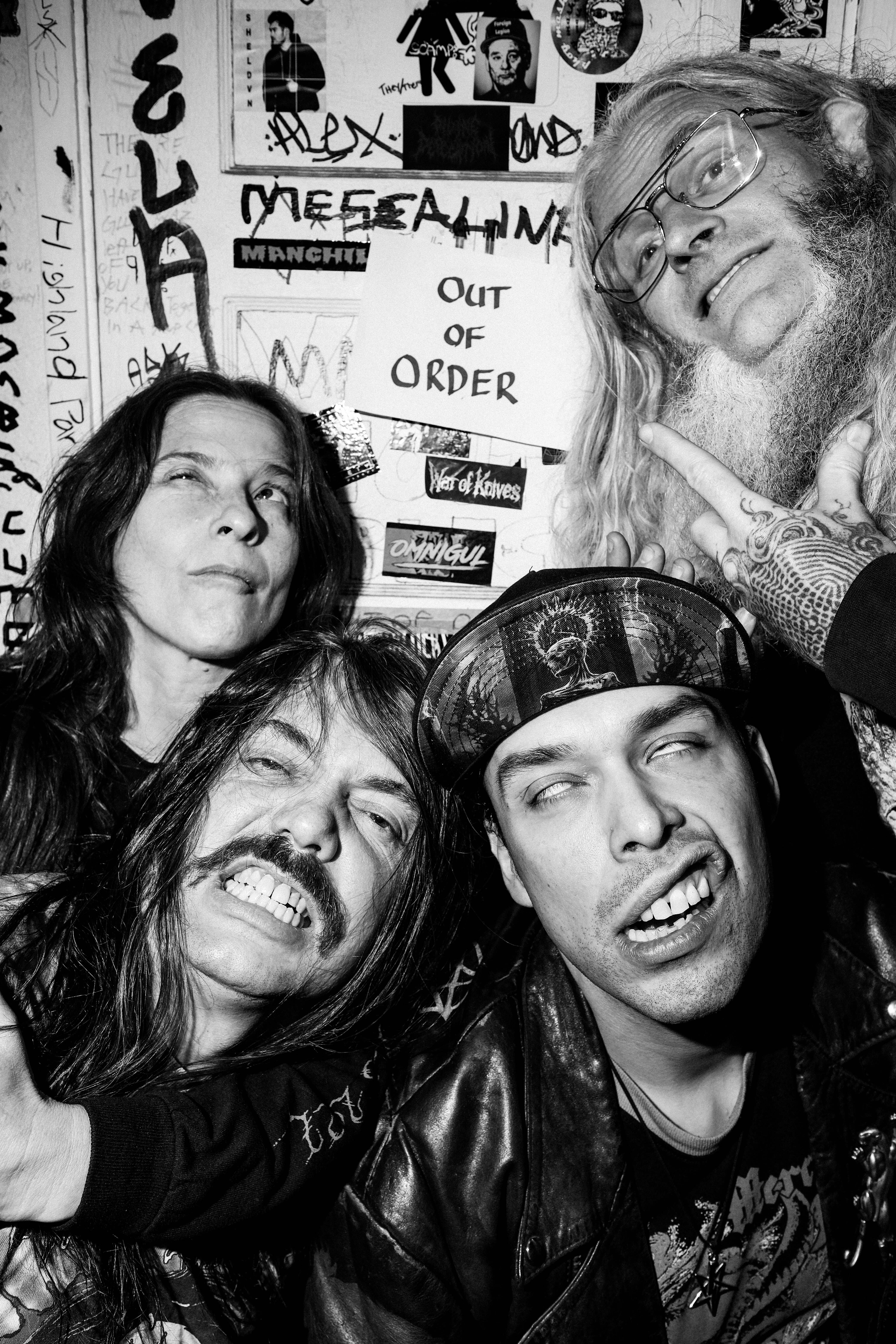
Deathgrave began in 2013 from a Bay Area network already steeped in punk, grind, sludge, and death metal. Guitarist Greg Wilkinson, bassist Fern Alberts, vocalist Andre Cornejo, and drummer Clint Baechle now sound fully settled into their shared language. Their history includes demos, splits, extensive touring, and two previous full-lengths. Yet Hell Is Evil feels like a culmination rather than another checkpoint.
“It’s kind of the Deathgrave record I’ve always wanted to hear,” Wilkinson says.
That assessment gets to the album’s central achievement. Its range has widened, but its identity has not blurred. Deathgrave have reached the point where expansion no longer threatens the architecture. Instead, the personalities involved define the architecture.
“I think that with the musicians involved, no matter what we do, it’s going to sound like Deathgrave,” Wilkinson says. “Listening back to even our demo tapes and our first album and other stuff, it still sounds like Deathgrave, no matter what.”
That confidence gave Wilkinson room to stretch his guitar writing after 2023’s It’s Only Midnight. He began looking for rhythmic spaces the band had not yet occupied and leaned further into the strange, noisy elements that had started creeping directly into his riffs.
Even his effects remain remarkably simple. Wilkinson relies primarily on distortion, delay, and occasional reverb. The point is not a tower of pedals. It is finding the correct shade of unease.
“I’ve got my delay pedal with a pretty tight delay on it, just to give it that weird, echoey, something’s-going-on-in-the-brain-down-the-hall feeling,” he says.
It is difficult to imagine a better description of Deathgrave.
Chaos with Shape
Much of that expansion owes to Baechle’s role behind the kit. Wilkinson says It’s Only Midnight, the first Deathgrave full-length with Baechle, helped the band discover what the current lineup could actually do. By the time they approached Hell Is Evil, the musicians understood one another’s instincts well enough to anticipate reactions before songs had fully taken shape.
The difference is especially apparent in the relationship between Wilkinson’s guitar and Alberts’ bass. Earlier incarnations of Deathgrave often demanded a tighter instrumental front. On Hell Is Evil, those parts can separate, argue, and reconnect because Baechle provides a rhythmic center capable of holding the disagreement together.
“There are definitely parts where Fern’s and my parts are allowed to be a little more loosely connected to each other,” Wilkinson says. “Now we have a drummer we can tether to. He can fill the gaps.”
That freedom gives Hell Is Evil a nervous elasticity. Thrash, doom, industrial abrasion, d-beat, noise rock, and death metal all enter the bloodstream. Yet this is not genre tourism. Deathgrave never sound as though they are consulting a checklist of extremity. Instead, they corrupt those elements until each belongs to the band’s own vocabulary.
There are limits. Wilkinson remains conscious that Deathgrave have one guitarist, so he avoids building studio arrangements that cannot survive intact onstage. Likewise, the band resist settling too comfortably into death-doom, despite their obvious aptitude for the form.
“We want to keep our overall theme fast, even though we do have doomy, sludgy parts at times,” he says.
The result is breadth without bloat. Even the longer songs remain impatient.
That balance also explains why Wilkinson speaks about the album as a unified object. He wanted intensity, but intensity by itself was insufficient.
“This record, from front to back, is musically exactly what I always wanted Deathgrave to be,” he says. “I wanted it to be relentless, but not just brutal. I wanted the listener to feel like there’s all this stuff going on and it’s a little crazy.”
More importantly, each track had to possess its own identity.
“On this one, I feel like the songs are puzzle pieces that fit together,” Wilkinson says. “The songs have stronger musical motifs separating them from each other, so it feels more like a complete story.”
Horror with Something to Say
Deathgrave’s absurdity has always had teeth. On “Born From Death,” however, the horror begins with an actual case. The song responds to the circumstances surrounding Adriana Smith, who was declared brain dead while pregnant and subsequently kept on life support.
For a band comfortable with monsters, bodily grotesquery, and surreal narratives, the temptation could have been to turn the story into another exercise in shock. Instead, Wilkinson says Deathgrave found a way to address something serious through the same distorted lens that has always defined them.
“In a lot of ways, Deathgrave is overall a fun band,” he says. “The way it’s kind of like sci-fi or comics; you can discuss an important issue without having to be completely literal.”
Cornejo transformed the subject into something closer to a nightmare narrative. However, the distance created by fiction does not erase the real event underneath it.
“It’s a very horrifying issue to talk about, but I think all of us agree it’s something worth talking about now,” Wilkinson says. “These are the kinds of dialogues that should still be discussed in music and in art.”
Elsewhere, Deathgrave even fold their own mythology back upon itself. Hell Is Evil contains a song called “It’s Only Midnight,” which shares its title with the previous album.
The joke is deliberate.
That record revolved around a demented neighborhood invaded by an increasingly unstable alternate reality. The band eventually realized they had constructed an entire scenario without ever fully explaining what happened to the unfortunate people living inside it.
“We wrote this themed album that never really explained the theme in the first place,” Wilkinson says. “We never actually buttoned it up.”
So Deathgrave did exactly that on the next record. Cornejo began throwing out lyrics about the neighborhood’s terminal prospects, and “It’s Only Midnight” became a loose epilogue hidden on Hell Is Evil.
“In a way, it’s almost like a button-up to the last album, contextually,” Wilkinson says.
Naturally, Deathgrave also enjoy the possibility that somebody might discover the song first and then fruitlessly search the previous album for the track whose title it bears.
Keep it Nasty
“Hard To Swallow” offers another example of Deathgrave’s increasingly porous creative world. The song features guest vocals from Autopsy’s Chris Reifert, Wilkinson’s bandmate in both Autopsy and Static Abyss.
The collaboration happened with almost comic simplicity.
Cornejo had a concept for a section that demanded something closer to a rant but had not found the right approach. Alberts suggested calling Reifert. Wilkinson sent a text asking what he was doing that day.
Reifert was free.
“So Chris came down, listened to the part, read Andre’s lyrics, and then wrote his own lyrics to fit in there so he could just do his thing,” Wilkinson says. “It was amazing. It made the song so much cooler.”
Wilkinson hears an interesting distinction between the two vocalists. Cornejo can lock tightly onto the rhythm, but he also possesses a broad range of extreme voices. Reifert works differently.
“He writes the ideas, and he’s able to soar on top of the music like a poet,” Wilkinson says. “He’s got a way of making stuff sound simple when it’s not.”
The spontaneity of that cameo reflects Wilkinson’s larger production philosophy at Earhammer Studio, where he mixed and mastered Hell Is Evil. Producing his own band once forced him to negotiate competing instincts. The guitarist wants his part heard. The engineer needs to hear the whole record.
“It took me decades to really master it, to be honest,” Wilkinson says.
His solution is distance. Wilkinson tries to approach Deathgrave as though somebody else handed him the files. He mixes as the recording develops, avoids becoming emotionally attached to preconceived sonic details, and resists the urge to fix a performance until its personality disappears.
“That’s the kind of booby trap you’ll walk into if you’re not careful,” he says of obsessing over how a recorded part differs from the version imagined beforehand. “Then all of a sudden you’ll overwork the song, and nobody in the band is going to be happy.”
The guiding principle is simple: capture the thing while it is alive.
“Don’t overcorrect your course, because people aren’t listening to grindcore and death metal for it to be completely pristine,” Wilkinson says. “They want it a little nasty and creative.”
So does Deathgrave.
Something Heavy in the Water
That nastiness also connects Hell Is Evil to the place that produced it.
Deathgrave’s members come from a Northern California underground whose bands rarely stay within neat stylistic boundaries. Wilkinson sees that culture as part of a larger Bay Area tradition, one in which musicians, filmmakers, visual artists, studios, rehearsal rooms, and small venues constantly overlap.
“The Bay Area has always had this magic,” he says. “There are always bands, creative arts, filmmakers and stuff.”
For Wilkinson, the difference is not simply the quantity of creative work. It is its character.
“People in the Bay Area are more raw and unfiltered in a lot of ways,” he says.
That underground can also disappear from outside view without actually disappearing. Wilkinson recalls periods when observers might have assumed the scene had gone dormant, while bands continued to play at places such as Burnt Ramen and Mission Records. Today, he sees another dense network growing around studios and rehearsal rooms throughout Northern California.
“There’s so much music happening around here,” he says. “I think there is definitely something heavy in the water here.”
Hell Is Evil sounds like a product of that water. It is a record built from different musical languages without surrendering to any of them. Deathgrave have expanded without sanding off their eccentricities. They have become more technically adventurous without confusing complexity for purpose. The album is brutal, certainly, but brutality alone is cheap currency.
These songs have hooks, strange corners, grim humor, structural intelligence, and the nervous movement of four musicians who understand one another well enough to pull in different directions.
That may be the real evolution from It’s Only Midnight to Hell Is Evil. Deathgrave no longer need every part moving together to prove they are the same band. Their identity is strong enough to withstand the friction.
Hell may be evil. Deathgrave make it sound remarkably inviting.
Photos by Matthew Kadi


