Portland, Oregon’s Magdalene reach their third album with Ashen. The album was released May 29, 2026. It does not treat heaviness as a matter of size alone. Instead, it treats heaviness as a body state. It is pallor, pressure, panic, and revival. For vocalist/guitarist Iul, the album marks a harder turn for the band. It also catches them in a rare state of total focus.
“Ashen is darker and more horrific than our previous works,” Iul says. “Ashen is a focused snapshot of what we are capable of on the spot, only working on our music.”
That last phrase matters. Magdalene have never sounded casual. However, Ashen feels unusually immediate. The record has the nerve of a document made under pressure. It does not sound careless. It sounds as if it was forced into being before doubt could kill it.
“I am grateful that this album came together almost as a Polaroid picture,” Iul says. “Writing this album was almost like answering a question. What do you sound like in this second, right now?”
From Portland’s Underground to a Three-Album Arc
Magdalene formed in Portland in 2020. Their current lineup centers on Iul, Rusty Powers, and David Brownett. From the start, the band treated genre like a failing wall. Black metal, hardcore, sludge, screamo, and post-hardcore all entered the room. None of them left clean.
Lightcarver, released in 2021, gave the band their raw first shape. It carried blackened crust speed, punk urgency, and a talent for ugly atmosphere. The Dying Process, released in 2023, slowed the blade. It made the band more patient, stranger, and more willing to let songs rot in public. Therefore, Ashen arrives as the third panel in a grim triptych.
That design becomes literal on “Bleed Through the Ashes.” Iul wanted the song to speak to the whole catalog. However, the process was brutal.
“I put that song through 19 revisions in about one week,” Iul says. “I wanted to write that song to reflect all three of our albums.”
The song becomes a map. Its opening looks back and centers decays. Its final movement points toward the new record’s darker weather.
“The opening riff reflects Lightcarver / ‘Exsanguination,’” Iul says. “The middle section reflects The Dying Process, and the end reflects the more horrific, focused darkness of Ashen.”
Pressure, Instinct, and the Right Kind of Force
Because of the time constraints, Ashen came together in a way Magdalene had not tried before. Normally, the band writes together in their practice room. This time, Iul built most of the music alone first. Then Brownett attacked the parts that still felt too square.
“Normally, we jam to write, and I will bring in a wireframe,” Iul says. “For this, I wrote almost everything in my office.”
That relationship gives the album its best tension. The songs have architecture, but they do not feel obedient. Instead, they lurch, surge, and claw at their own frames.
“David brought a lot of my farther-flung ideas back down to Earth,” Iul says. He also “ramped up the aggression with some of his knee-jerks and instincts that no one else I’ve ever played with can replicate.”
The record also allowed Magdalene to bend their own rules. Iul points to three choices that pushed the band outside their usual formula. One was a melodic guitar solo. Another was the clean vocal passage from Theo Spence of Rank And Vile on “Aqabal.” However, the third choice may best explain the record’s texture.
“I’m also proud of the guitar feedback on this album,” Iul says. “We recorded this album twice. Once live and once to clicks in two different studios.”
Feedback can become costume when added after the fact. Iul knew that risk. However, he wanted the noise to feel alive. He brought his ’70s Strat to the rehearsal space after tracking. Then he chased the sound physically.
“I spent the better part of a day angrily whirling around and flinging my guitar,” Iul says, “and got some pretty sick feedback sounds.”
Helvete Sound, Personal Hell, and a Death-Pale Title
Ashen also benefits from a mix that understands impact as more than volume. Joe Anderson at Helvete Sound helped give the record sharp edges and weird undercurrents. For Iul, the result was unusually fast and unusually right.
“Joe Anderson at Helvete Sound did such a good job on this mix,” Iul says. “The mix was so close to perfect on the first pass.”
That is not faint praise from someone who listens like an engineer. Iul says he can be difficult during a mix. Still, Anderson did more than satisfy a checklist.
“Joe went beyond just producing a near-perfect mix,” Iul says. “He experimented and got super artsy with the low-end of the record and compression.”
That attention gives Ashen a severe physical character. The bass does not merely support the guitars. The drums do not merely mark time. Instead, the record feels pressurized from below. It is as if the room itself has decided to become hostile.
For all its symbolic smoke, Ashen is also personal. Iul usually avoids writing in a direct, visceral mode. This time, speed changed the method. It also changed the result.
“I usually steer clear of writing anything visceral,” Iul says, “but due to time constraints, I lifted that restriction and just wrote about stuff that was personal to me.”
Still, Magdalene do not make diary entries. The lyrics pass private material through infernal imagery and ruined landscapes.
“I, of course, shrouded everything in deep hellish symbolism and dystopian imagery,” Iul says.
The song “Elsmere” cuts closest to the bone. Its details are disguised. However, its origin remains private and specific.
“‘Elsmere’ is deeply personal to me,” Iul says. He explains that it “describes the street I grew up on, and just basically doing everything you could possibly do wrong as an adolescent.”
The album also turns outward. “Canopy” gives the record one of its clearest social images.
“‘Canopy’ is probably the most on-the-nose,” Iul says, “as it compares capitalism to the various layers of a rainforest.”
However, the album title carries the deepest double meaning. It suggests death, but not only death. It can describe the color draining from the face as well as the body after death.
“To me, Ashen describes someone’s complexion when they are close to death,” Iul says, “or, as my good friend Jameson Shaw said, also someone’s complexion when they are revived.”
A Gut Punch in Violet, Then Revival
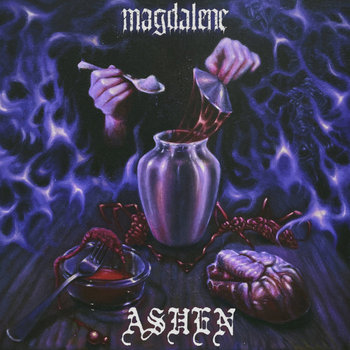
The cover art makes that ambiguity visible. Portland artist Joey Coray created the image after Iul saw Coray’s piece “Jonsing.” The work gave him a sense that the album could look as severe as it sounded.
“I knew at that moment that it would be possible to create the next Magdalene album cover like a gut punch,” Iul says.
Coray also tied Ashen back to The Dying Process through color. That detail gives the visual world its own continuity.
“When we were nearing completion, Joey added dioxazine violet (good Scrabble word?) as a reference to a color from our last album, The Dying Process,” Iul says. “This color is symbolic of our last album reflecting onto the current.”
Magdalene balance atmosphere and aggression with little apparent ceremony. For Iul, those forces are not layered later. They are already there.
“Atmosphere and aggression are always pre-installed,” Iul says. “We are lucky that we get to just do what comes naturally in this band.”
That natural state is not gentle. It comes from punk history, blackened dissonance, and the percussive severity Brownett brings to the songs. However, the destination is not simple punishment.
“As I mentioned about the title Ashen, I hope they feel revived, but more importantly, surprised,” Iul says. “I also hope that, for people who have been following us over the years, this third album has provided some closure to the trilogy we’ve released since 2021.”
That trilogy now feels complete. Lightcarver cut the first wound. The Dying Process studied the wound as it worsened. Ashen stands in the smoke after the body fails. Then it dares the body to return.
Therefore, Magdalene do not make Ashen sound like a career move. They make it sound like a question answered at high volume. By the end, the listener is not cleansed. Instead, they are shaken back into the body.
Pic by J. Donovan Malley