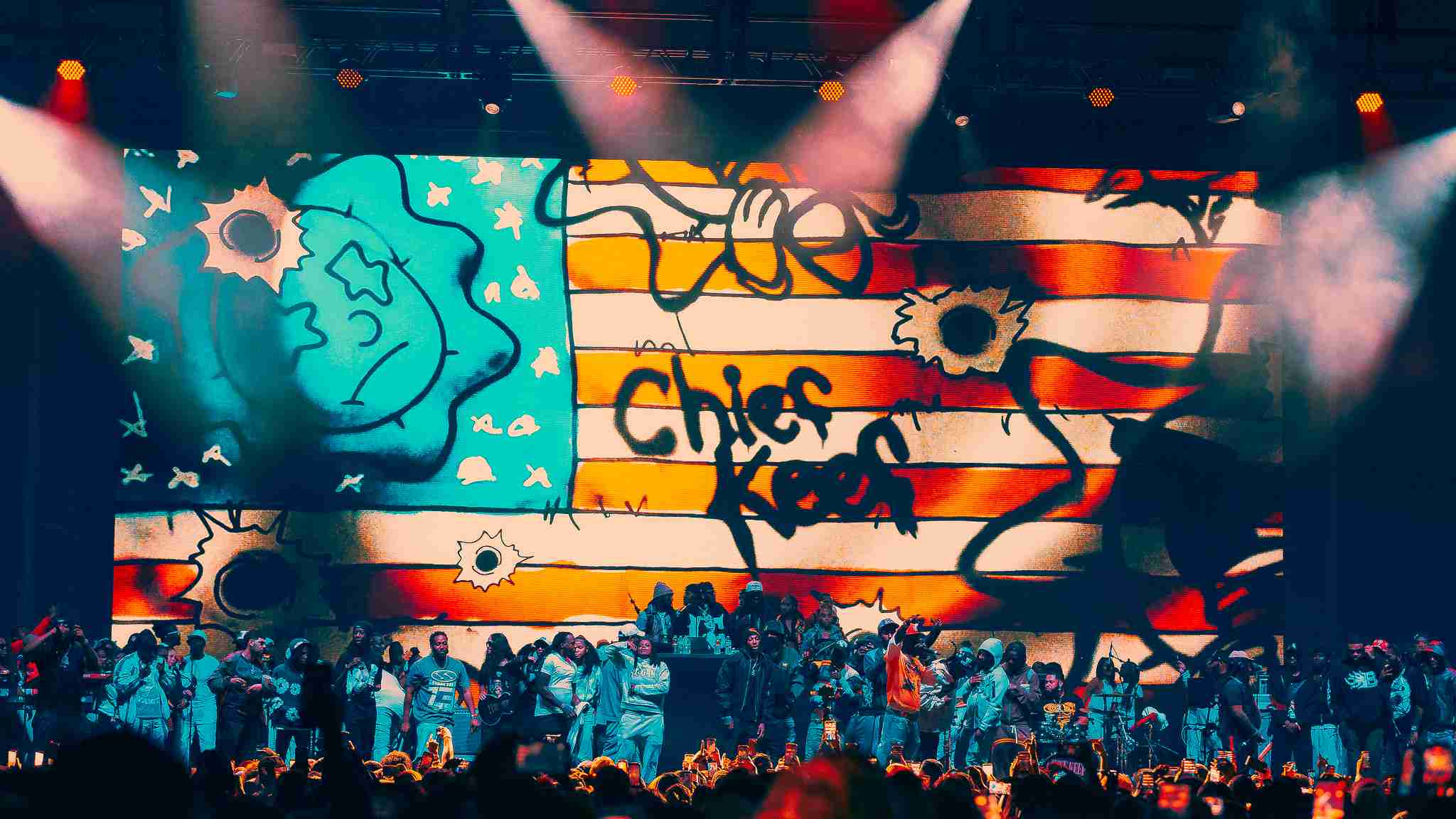

There are concerts, and then there are moments that feel bigger than the show itself. Chief Keef’s return to Chicago was always going to be the latter. Fourteen years after his last performance within Chicago city limits (last one being Lola in 2012), the South Side-born rapper finally returned home for a long-awaited headlining performance at Huntington Bank Pavilion at Northerly Island. What should have been a triumphant September 12 homecoming instead became a two-week exercise in anticipation, frustration, and patience before Keef finally took the stage on September 23.
The original September 12 date had already generated an enormous amount of anticipation. For many fans, this wasn’t simply another stop on a tour, it was a chance to see one of Chicago’s most influential musical figures perform a proper hometown show for the first time in 14 years. While Keef had appeared at Lyrical Lemonade’s Summer Smash in Bridgeview in recent years, his Northerly Island performance marked his first show within Chicago’s city limits in more than a decade. Then, just as thousands of fans were arriving at Huntington Bank Pavilion, everything came to a halt.
The September 12 show was postponed roughly 30 minutes before Keef was scheduled to take the stage, with the venue and Keef himself citing travel delays resulting in the performance being rescheduled. To say fans were disappointed would be an understatement. For a concert that had been 14 years in the making, on top of Keef having just been in Chicago the previous week for Kanye’s Soldier Field appearances, the timing could hardly have been more frustrating. Fans had already traveled, waited in line, dressed for the occasion, and built up what had become one of the most anticipated Chicago hip-hop homecomings in recent memory. Suddenly, the crowd was being asked to go home and come back nearly two weeks later. On the way out, fans tried to keep their heads up about the situation hoping the rescheduled date would work for them, while others chanted “Durk would neva!” Regardless, the postponement only added another layer to the story.
By the time September 23 arrived, the sense of anticipation was impossible to miss. The crowd knew exactly what they were waiting for. When the lights finally went down and Keef emerged, the reaction felt less like the beginning of an ordinary concert and more like the release of fourteen years of pent-up anticipation and suddenly, everyone forgot about the stress and disappointment of the rescheduling.
Opening with “B**** Where,” Keef immediately established the tone for the night before moving through a set heavily populated with the songs that helped define his place in Chicago music history. “Bang,” “I Don’t Like,” “Hate Being Sober,” “Love Sosa,” “Kills,” “Hadouken,” “Save That Shit,” and “Save Me” all made appearances, giving the crowd plenty of opportunities to erupt alongside him. Keef kept the bangers with tracks like “Sosa Chamberlain”, “Love No Thotties”, and “Macaroni Time” even hitting a rock block of deep cuts like “Buy It,” “Hiding,” “Salty,” “Hoez’n’oz,” and “Aint Done Turnin Up.”
The energy throughout the pavilion was fueled by recognition. Every familiar opening beat seemed to trigger another wave of voices from the crowd. Songs that once represented the raw sound of Chicago’s early-2010s drill movement now function as something closer to generational anthems. Hearing thousands of people collectively shout along to “I Don’t Like” or “Love Sosa” demonstrated just how deeply those songs have embedded themselves into Chicago’s musical identity.
Keef himself maintained the relatively loose, understated stage presence that has become part of his persona. Rather than spending much of the evening addressing the crowd, he let the songs carry the weight. That approach worked particularly well when surrounded by the right people, with Ballout and Tadoe bringing additional energy and chemistry to the stage. One of the night’s biggest surprises came when Chance the Rapper joined Keef onstage for “No Problem.” The appearance represented another collision of Chicago generations and musical worlds, with two artists who emerged from very different corners of the city’s hip-hop landscape sharing the stage during one of Keef’s most significant Chicago performances.
Something I really enjoyed and appreciated was the inclusion of a live band providing an unexpected dimension to some of the older material. “Love Sosa,” “I Don’t Like,” and “Earned It,” took on a heavier, more aggressive quality with live instrumentation, giving some of Keef’s earliest material a fresh edge.
Ultimately, the significance of the night extended beyond the individual performances. Chief Keef’s music has spent more than a decade influencing Chicago, hip-hop, and popular music far beyond the city where it originated. As someone from the area, I can confirm just how big a deal Chief Keef’s come-up was back in the day. Just like how we all remember Chance the Rapper’s come-up. Kanye or even Lil Durk, Chief Keef was the exact same way. His return to Chicago therefore carried a different weight than a typical tour stop. This was an artist returning to the place that helped create his mythology, performing songs that had grown from local anthems into pieces of a much larger musical legacy.
There was something fitting about the imperfect path to the performance. The postponement, the uncertainty, the extended wait, and the eventual release of finally seeing Keef back in Chicago all became part of the story. Fourteen years is an extraordinary amount of time to wait for a hometown show, and the crowd carried that history with them into the pavilion. Closing out with “War” into “Earned It” and then, finally, “Faneto,” it brought the night to its epic, explosive conclusion. After all the buildup, the frustration, and the years spent waiting, Chief Keef was finally back where it all started. After 14 years, Sosa finally got his homecoming.