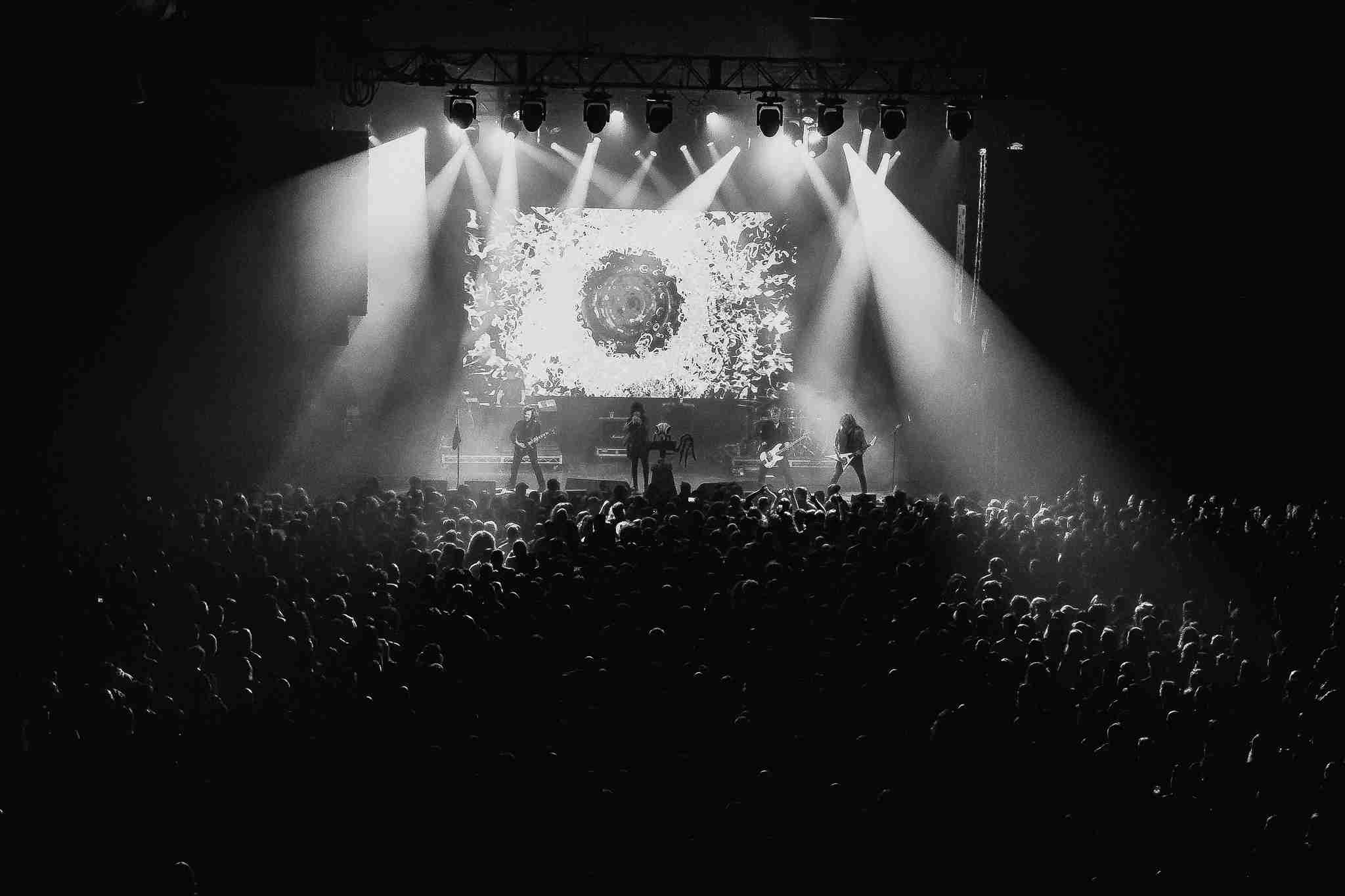

There are few combinations in heavy music that feel quite as perfect as Ministry and Acid Bath sharing a bill. One helped redefine industrial metal by turning mechanical repetition, electronic noise, and sheer aggression into something genuinely dangerous, while the other took sludge, doom, psychedelia, and southern gothic darkness, twisting them entirely their own. Seeing the two bands together made for a night that felt less like a traditional metal show and more like a collision between two very different forms of heaviness.
Opening the night, Windhand set the tone with a slow-burning blend of doom, psychedelia, and crushing fuzz. Their massive guitar tones and droning rhythms created an atmosphere that felt heavy without being rushed. The band’s ability to balance dense, punishing passages with more hypnotic moments made them a fitting addition to a bill that would eventually move through the murky weight of Acid Bath and the industrial assault of Ministry.
Acid Bath came out on stage like they never left. After years of existing primarily as a legendary name in underground metal that was no longer active, seeing the band’s music brought to a live stage carried a significance that went beyond simply hearing the songs performed. Their sound has always had an almost uncomfortably intimate quality, and live, that darkness felt even more pronounced. Now their third time in the Windy City since returning, Acid Bath already knew the Chicago crowd would be fired up and ready to rock with them.
The band’s combination of crushing sludge riffs, doom-laden passages, punk aggression, and psychedelic weirdness remains remarkably distinctive. Songs such as “The Blue,” “Dr. Seuss Is Dead,” and “Jezebel” moved between crushing heaviness and more atmospheric moments without ever losing their unsettling edge. There is something inherently chaotic about Acid Bath’s music, and that unpredictability translated beautifully to the stage, especially how well-aged the music has become.
What made the performance especially effective was how much space the band allowed its heavier moments to occupy. Rather than simply racing from riff to riff, Acid Bath let the weight of the music settle in. The result was a set that felt enormous without needing to rely on spectacle. For longtime fans, it was an opportunity to experience songs that have spent decades existing as cult classics in a setting that finally gave them the physical presence they deserve.
From the moment Ministry took the stage, subtlety was essentially abandoned. The band’s performance was an assault of distorted guitars, pounding industrial rhythms, electronic noise, flashing visuals, and the unmistakable presence of Al Jourgensen. After more than four decades of Ministry, there is no need for the band to prove its place in industrial music, but the performance made it clear that Jourgensen has no intention of treating the band’s legacy like a museum piece.
The set moved through the many different eras of Ministry’s career, but the classic material remained the centerpiece. Songs like “Just One Fix,” “N.W.O.,” “Thieves,” and “Jesus Built My Hotrod” hit with the same mechanical force that made them so influential in the first place. Live, those songs become less about individual riffs and more about momentum. The rhythms lock into place, the guitars become almost physically abrasive, and the entire performance takes on the feeling of something constantly moving forward. Even more exciting was Ministry blessing us with not one, but two new unreleased tracks being played for the first time.
There was also an undeniable sense of confrontation to the performance too. Ministry has always understood that industrial music works best when it feels uncomfortable, and the band’s live show embraces that quality. The combination of aggressive imagery, pounding electronics, and Jourgensen’s commanding presence created an atmosphere that was intentionally overwhelming. By the end of their set, the room had become completely consumed by the performance. The pounding rhythms and distorted guitars turned the venue into a wall of sound, while the crowd responded with an energy that equally matched the band’s intensity.
A night featuring Acid Bath and Ministry was never going to be particularly subtle, and thankfully, it didn’t try to be. It was a celebration of two radically different approaches to heavy music, one rooted in sludge, doom, and underground weirdness, the other built from industrial noise, technology, and sheer aggression. Decades into their respective careers, both bands proved that heavy music can still feel dangerous and boundary-pushing when the right artists are willing to take it far enough.
Ministry


Acid Bath


Windhand