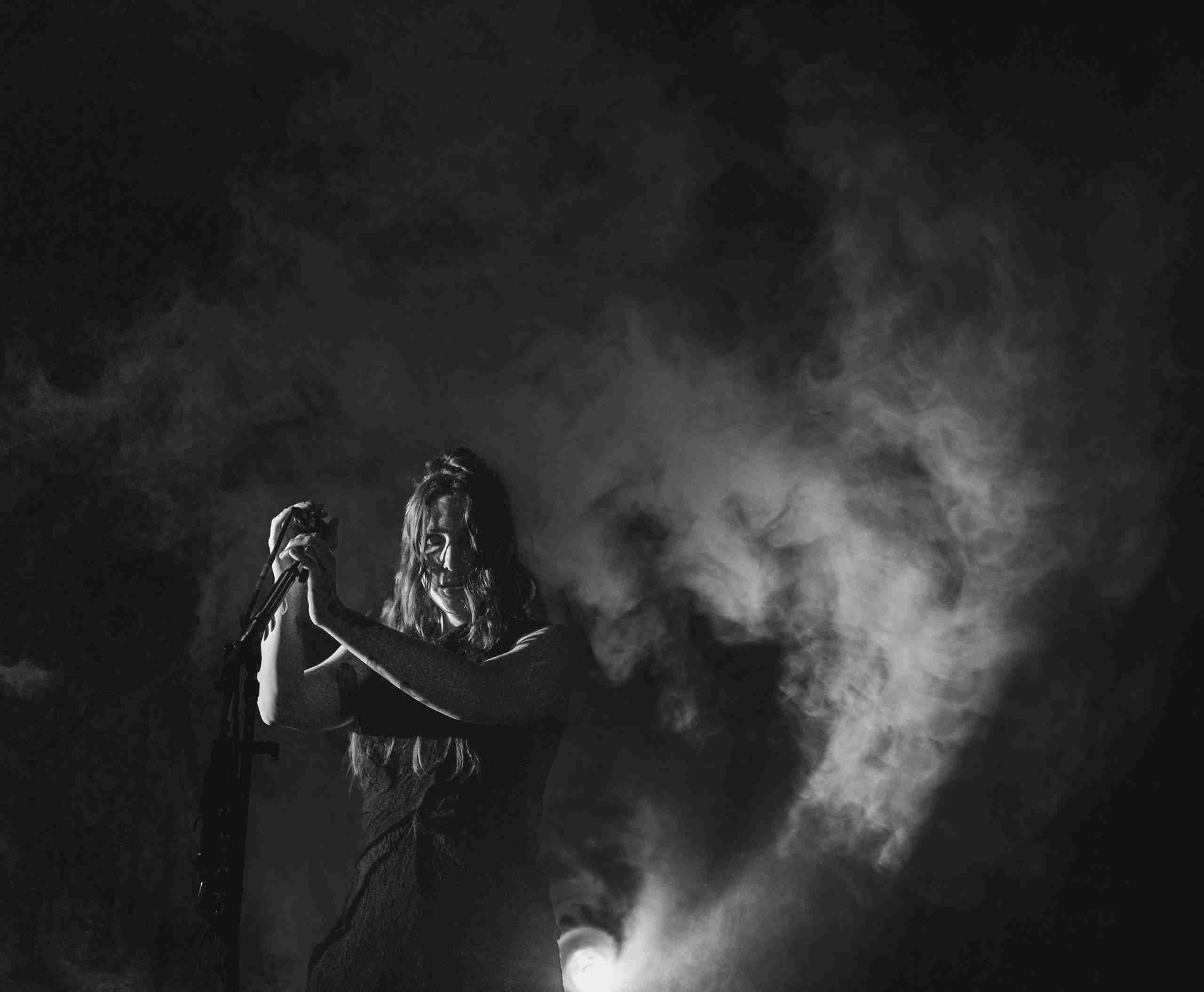

In a world all her own, Chelsea Wolfe’s music exists within liminal spaces, those between fear and power, longing and surrender, light and dark … even life and death. What Wolfe has come to realize is that nothing is one sided. We can’t have the good without the bad, and sometimes the only way to get where you want to be is to embrace both sides of the coin. Her newly released album, The Dark, out now via Loma Vista Recordings, does just that. On her journey to creating this record, there was an element of unraveling that had to happen in order for her to begin anew. And while we are all prone to be creatures of habit, being more intentional with boundaries and learning to prioritize herself when it counts helped her break through to the other side.
Throughout her career, Wolfe has been a vivid storyteller who allows the listener to feel as though they are a part of that journey with her. In creating this album, she was able to interpret her ongoing experiences through music in real time, for the first time. With The Dark, the title takes the form of several literal and metaphorical thematic symbols. It represents mourning in the wake of tragic loss, and, in a similar breath, also represents coming to terms with a severed relationship. Yet, in the midst of all this poignancy, seeds have a way of stirring buds. Wolfe’s intention was to show that we can work to have control over what connotations we attribute to things based on emotional reactions. Dark spaces don’t always have to be sad or scary; they can also be a place full of resurrection and whimsy, if we let them.

I want to start off with your wardrobe. The aesthetic you present is very witchy, ethereal, and Victorian gothic. Is that something used to romanticize your artistic persona or has that always been part of your personality and inherent fashion choices?
I was first starting out playing shows in my very early 20s. I grew up in Sacramento, California, and downtown, there’s a lot of Victorian homes there, and you end up living in, like, a room in these old Victorian homes. My friends and I got a bunch of used books, and there was one that was on Victorian morning dress. I had a show that night, and I was really nervous about it, and literally, I was just like, I’m gonna dress like one of these Victorian ladies in mourning. I wore a long black dress and found an old lace shirt and cut it into a veil. I found that it actually made it so much easier because I could just become this sort of entity and focus on the music.
It came to very mixed reviews; a lot of people were like, what the hell is she doing? Who is this weird lady? But I enjoyed it. So I did that for a number of years. And then eventually, when I released my album Apokalypsis, (and) one of the sort of root meanings of that is lifting of the veil.
So I felt like it was time to sort of literally do that. And I did that in a show in New York. It was, like, partway through the show, and I took the veil off. And it was like, I’m stepping into being seen a little bit more. I feel like tying in fashion and costume into my music has been a pretty intrinsic part of it, but I don’t think it’s defined by it.
Let’s talk about sobriety; it’s a topic I really like to delve into because I got sober from alcohol three years ago, and it really did transform my life and my overall outlook. What spurred your journey towards sobriety, and in what ways did it impact your approach when you were ready to start making this album?
I got sober in 2021 while I was making my last record, She Reaches Out, and it had a pretty big impact on that record, just feeling more clear and present and sort of easing into being excited about life again. When you have gone so long living a certain way and being in a constant fog of hangovers and things like that, it felt so exciting that I could actually live in a different way.
And it’s not as boring as everyone says it’s going to be. It’s actually more exciting because you’re feeling things a lot more, and you’re a lot more present for everything.
But after a few years, I just realized that I wasn’t actually making enough decisions for myself. Like, I was abandoning myself, and I was really putting everyone and everything around me before myself, before my own needs, before my music, even. So at some point, I was so incredibly unhappy that I actually started drinking again for a few months. I was just literally like, I have to get through this … I have all these obligations; I don’t feel like any of it is actually right for me, but I have to do it. But I quickly realized that doesn’t work and was not helping at all.
So thankfully I was able to get sober again, and this time it’s been a lot more intentional. I’m taking it a lot more seriously. Last time there was kind of a notion that maybe at some point I could start drinking again. But once I did, I was like, oh no, I actually can’t. So this time, it feels a lot more powerful and also empowering. I just feel really good about the decision to be sober this time. I feel like it affects everything.
I can’t say enough good things about “Cold;” I really can’t stop listening to it and I don’t think I’m alone. It seems to be a fan favorite from the album, and I don’t know what it is but even when I heard it for the first time, it felt so familiar. What feelings were coming up when you wrote this? Is it metaphoric or based on a prior relationship?
“I’m letting you go”—It states that at the beginning of the song, and that first line is very direct on what I’m going to be doing, but it’s also complicated. The music video that I made for it was really inspired by this movie The Others. In the film, it’s about people in a house being haunted by ghosts, but the ghosts in the house are also haunted by the living people that live there. So I was thinking about relationships and how it’s not always clear-cut who is mistreating someone.
There’s a lot of relationships where it’s just two people who are not right for each other, who are trying to make it work and end up just feeling cold, is the most basic way I could put it. Just feeling that sense of lying in bed next to someone, and you feel more alone than you would if you were actually alone, and feeling like you’re going cold because it’s not the right place for you, but you’re staying anyway.
So, yeah, I mean it’s really such a simple song, but it’s about thinking about things in less of a black and white, like good, bad. Really, we are toxic for each other, and I’m finally going to make the decision to end this relationship, even though maybe I love you, even though I care about you, I don’t think you’re a bad person. I don’t think I’m a bad person, but this just is not working.
So that’s where that song is coming from. But I understand that it could mean so much to so many different people, which is the hope.
I also am someone who is not afraid to talk about death and believe that westernized culture is extremely avoidant. Your lyricism softly opens the door to that subject, and I want to just pry into that a little. You have a song, “Death Is Not The End,” do you have your own construct of what comes after death, or is it that there’s some comfort in accepting that death is inevitable, and what comes next is just a journey into the unknown?
One of my earliest visual and cinematic references was The Seventh Seal by Amor Bergman and this literal figure [character] representing death in the film that you can speak with and interact with and see in front of your eyes. I was very intrigued by that at a young age, and that’s always stuck with me. At the same time, I’ve always explored the concept of the dark in different ways, mostly inspired by having a lot of sleep issues as a young person and feeling like the space between realms is hazy. Attributing that from the space between sleeping and waking into the space between death and life and these hazy in-between places, that’s in a lot of my music.
I was really exploring that on this record, especially on “Death Is Not The End.” Even musically, there’s a very clear shift from the acoustic wandering space into a heavy opening up into something different. The lyrics from that song came from personal grief and understanding that when someone you love passes, it’s not like they’re gone, they actually become so much bigger, and you can feel them in such a different way. It just becomes like they’re everywhere in a sense, and their spirit becomes bigger in my opinion. So while I don’t know what happens after death … I could just sense that our energy expands, and I thought that was really beautiful.
I had done a sort of personal seance ritual to connect with my great grandmother and her sister, my great aunt, who were very close, and I had been doing that kind of work to connect with them. I felt that sort of message is what came from (it), that as death is not the end. So that’s when I say, “she said, death is not the end,” I’m speaking about my maternal great grandmother.
You featured several different musicians throughout the record; can you tell me about who you worked with and what it was that drew you to them?
For this one, it was the music informing everything because we were so focused on songwriting initially and focusing on the sort of structures of the songs. Then it was like, let’s put a list together of dream players that we feel would work well with these songs, and thankfully they all said yes. I just felt like it really was the right people, intuitively, to add to these songs.
I really wanted to make sure that as much as possible I was having people come into the studio and be in the space with us. There were a couple of things, like I had my friends in the band Kælan Mikla in Iceland do some vocals, and so obviously that was done remotely; they sent us elements to incorporate. But yeah, when we had drummers like Stella (Mozgawa) and Matt (Chamberlain) and guitar players like Troy (Van Leeuwen) and Robin (Finck) come in, it was it was really important for me to be in the room and to just be bouncing off each other in real time.
Your collection of music is quite robust; you’ve gone through many eras over the past 16 years and have shown us such a far-reaching range as far as your vocal, instrumentation, and production styles. But now, on this record, you worked with a co-songwriter for the first time ever. Why now? It seems like something people might do at the start of their careers rather than at the height of it. Was it hard for you to relinquish that control over the lyrical direction?
Yeah, I mean, I wanted to get out of my comfort zone. Like you said, I’ve had so much music at this point, I’ve been doing this for so long. And while each record process has been really different, I do spend a lot of time alone writing and just wanted to create a space where I was sort of forced to do something different.
Signing up to work with a songwriting collaborator was exactly that. Having these periods of time, a container where I would go to her studio and just write in a different way and have someone else’s ideas and perspective. It was cool too because we’re pretty much the same age, both women in this industry, and she was also pretty newly sober at the time. We’re very different people, but we have a lot of similar experiences and if I would talk about something, she could give me her reflection and perspective back on that. She was really encouraging me to put what I was going through in real time into the songs, which I don’t always do as well. So that was an interesting, new thing.
And again, I really wanted to get out of my comfort zone, get out of the cycle that I had been doing over and over. It’s not actually easier, in my opinion, for me to write with someone else. You know, it’s maybe more challenging because there’s just a lot of back and forth and a lot of ideas going in that you have to sort through and make sure to keep checking in with yourself and make sure it still feels right, even though it’s coming from someone else.
In what ways did you approach this album differently than past albums, and in what specific ways do you think creating this album made you a better musician overall?
Because the album is thematically dark and deals with letting go and relationships and death, I wanted to bring some lightness and some playfulness to it as well. I kind of always do that in a way of wanting to bring a little bit of hopefulness or some bite and determination and not just let it be totally dragging you down. I’m not really interested in music that’s gonna make you feel worse, or depressive. Even though it’s sad or heavy, I always want to make music that you can sort of lean into and maybe feel like you’ve been able to go through it with me and process something.
You know like after you have a good cry you feel better ultimately, even though it doesn’t feel good at the moment to let yourself cry. But yeah, all this to say I kept this phrase of dark whimsy at the top of my mind, wanting to allow some playfulness and some whimsical energy into the fold and, you know, I was doing that with visuals but also with the sound.
You seem to me like someone who interprets experiences and stimuli through music. In what ways does it help you to process, or work things out, and is making music a way for you to come to terms with what’s happening to you or in the world around you?
I think that so many of us are able to better understand our own lives in this chaotic, often confusing world that we live in through a mythical lens and through fantasy and through art. So I guess I’m trying to do the same thing, taking a really simple subject and putting this mythical story around it.
You realize it’s not as simple as it might seem. It can be about transformation or loss or healing and yeah, putting that sort of mythical, fantastical lens around my own life experiences and putting that into music has been my way of processing and understanding. When I’ve written a song that feels like it’s helped me to understand something in my own life or in the world, it doesn’t mean that I’ve completely come to terms with it or I feel like, oh that’s done now; it just helps me to feel a little bit more at peace and like I can continue on the path.
The Dark is out now via Loma Vista Recordings. Get it here.
Photos by Sophia Gabrielson