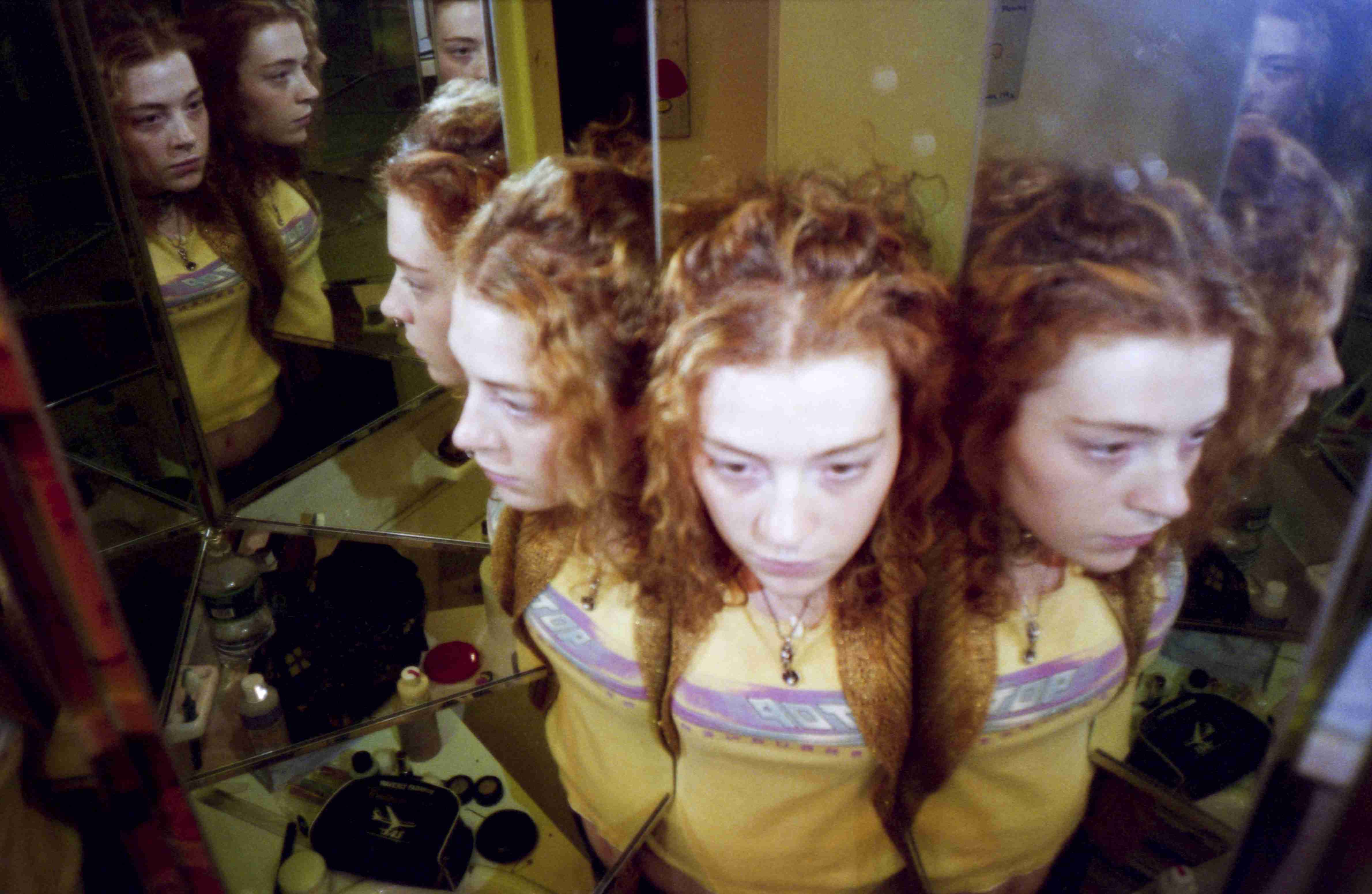

When Melissa Auf der Maur answers my phone call, as she sits on a train traveling to her native Canada, she tells me that this may be her first conversation solely dedicated to her new album, BASS WOMB ROOM: My ’90s 4-Track Demos x Field Recordings, her first musical offering in 15 years out now via Envision Records.
Perhaps you’ll recognize Auf der Maur from her tenures as the bassist of Hole and Smashing Pumpkins, respectively, from the mid-1990s to the early aughts (it was frontman Billy Corgan who suggested a then-22-year-old Auf der Maur to Courtney Love in 1994). Or, you’ll recognize her solo work—two solo albums, numerous musical collaborations, and a vast photography portfolio—and co-founding of Basilica Hudson, an arts and music space in Hudson, New York.
Now, in a post-analog world inundated by technology, over-curation, and often-mindless doomscrolling, Auf der Maur has returned with a sense of urgency, to remind generations—whether they remember the ’90s or were not yet alive—of the beauty of the decade’s imperfections.
The “interesting little sister” of her multimedia memoir, as she affectionately refers to BASS WOMB ROOM, has been somewhat eclipsed by its siblings: a highly-anticipated memoir, Even The Good Girls Will Cry, a photo book, My ’90s Rock Photographs, and its accompanying photography exhibition at the Art Gallery of Ontario. But now, the album emerges as what may be Auf der Maur’s most personal work of all, a raw depiction of her youth that allows us into the hypnotic and overwhelming facets of her brain.
The album was, in her words, “a bit of an intimate afterthought” first conceived as an ambient score for her museum exhibition. She consulted her old hard drive for sonic elements that would bring her photographs to life: field recordings, old samples, etc. Then, she stumbled upon old songs, nearly forgotten over time and lost in the archives. One of these, “…And The Next Day,” is the first full song on the album, left out of Auf der Maur’s mind from when it was recorded onto a cassette in 1998.
She remembers such recordings as attempts to find her voice as a musician, of which she was not sure would be worthy of an actual release. “I just realized that if I’m sharing all the stories of orgasms and nosebleeds in my memoir, and I’m unearthing all these photos of messy bedrooms,” she explains. “Why not just have the sonic equivalent of that?”
BASS WOMB ROOM is a curious listen within the eye of the storm that Auf der Maur was surrounded by, at the height of the mania that enveloped her as a touring musician. Field recordings capture her days spent traveling from one city to the next—“real On the Road vibes,” she says. Nights performing on-stage for thousands are simultaneously spent indulging her “documentarian impulse,” as she calls it, by photographing and recording both herself and the crowd via cameras perched on an amplifier, a subversive challenge to the surveilling eye of a fan.
Even later nights were spent alone, recording as she read out-loud from her diaries, strumming a guitar and singing to herself without intending for anyone to hear. Importantly, all was done as a conscious stance against the pressures of a major label, which began to distort her relationship to music.
“Because I lost so much of my innocence and love of music to that machine,” she reasons when asked where this defiant mindset came from. “Even though I was the luckiest person, relatively speaking … I’m very, very lucky to have experienced music at the level and scope that I did. But, it was not an easy, nurturing, joyful ride, a lot of it.” This is a subject that she dives into deeper in her memoir, how being in two of the biggest bands of the ’90s strengthened her character but was not as liberating as one might suspect.
“It was a two-sided, weird thing for me, a bit like the public life and the personal life in the bathroom,” she says of her career in music. “I was trying to stay pure in both contexts, but it’s really hard to be pure in a capitalistic, power-hungry world.”
As Auf der Maur unearthed more of her demos, the ones that jogged her memory the most were the experimental ones, Lynchian in their distortive, compelling melodies. She speaks fondly of one titled “Is She His?” a surreal trip into a love story. “I want to look at his eyes and see his soul,” she drones, her voice reverberating as though traveling through time, “But at the same time, I’m preoccupied with the surface of his skin …”
“To be honest, it’s the most ‘me’ of all of them,” she admits of the song, “and it’s as simple as, all the lyrics are just one page of a diary. Then, the technology component of flipping a tape and making the soundtrack be backwards … and then fucking around with the pitch of my voice, to explore what it’s like to be androgynous, to be a little baby … It was just my version of a diary in audio format (that) I’m proud to share because I guess I’m weird.”
She remembers recording the song during her time living in Silver Lake, having just moved to Los Angeles and living with Hole’s then-drummer, Patty Schemel, in 1996. This period was in-between the Live Through This tour and the writing of its follow-up album, 1998’s Celebrity Skin, the first to feature Auf der Maur’s bass and vocals. Left to idle as Courtney Love ventured into Hollywood films and contracted exclusively to Hole, recording demos in her home was a solace for Auf der Maur.
“I was just sort of trapped in my life,” she recalls with a slight laugh. “I also was mostly single in the ’90s, so it was probably exploring the question of, what is intimacy to me? What is sensuality? I was very exploratory in my 20s because that was the spirit of the ’90s, much like the counterculture of the ’60s … I didn’t look for a boyfriend and a husband. Some people in their 20s might be looking to buy a house and get a job, but I was just living in some kooky, experimental reality in a rock band.”
On BASS WOMB ROOM, the young girl from Montreal who, as a teenager, would decide to devote her life to music, is allowed to exist freely—even if it means having to live in the confines of, say, a hotel room or a tour bus. Each song becomes an intimate glimpse into her private world, desperately trying to retain her innocence in an industry that was otherwise set on corrupting it. This vulnerability that is woven into each song is one that Auf der Maur admits she “still feel(s) a little awkward about,” explaining that a long-crafted, 400-page memoir is much different than the unrefined display of herself that her demos offer.
“When I saw all those bands emerging in 1990, 1991, everyone was a fucking mess in the best way,” she says. “And when I listened back to those demos, I thought, I was still just true to the spirit that made our magic carpet ride of the Gen X music. I’m embracing the innocence of just feeling like, ‘I don’t care if this is a good song or a bad song; I’m just gonna be it.’ So in some ways, my sonic component to this multimedia memoir is the most true to the ’90s spirit.”
It is Auf der Maur in conversation with her younger self in a way, looking back and realizing that not too much has changed—At her core, she remains committed to artistic freedom.
“To be honest, I worked hard to write a really good book, and I worked hard to make a really impressive museum exhibit,” she says. “And in a good way, I did not work very hard to make a soundtrack. I just let my 20-something-year-old self do the work back then.”
BASS WOMB ROOM is out now. Get it here.
Photo courtesy of Melissa Auf der Maur